
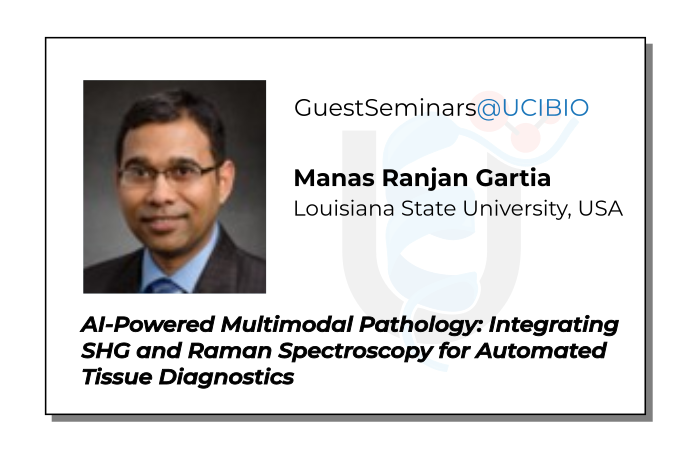
AI-Powered Multimodal Pathology: Integrating SHG and Raman Spectroscopy for Automated Tissue Diagnostics
Manas Ranjan Gartia, Department of Mechanical and Industrial Engineering, Louisiana State University, USA
Host: Sara Ricardo, UCIBIO Porto
Online Link: https://ucibio.pt/l/GuestSeminars
Abstract:
Automated pathology driven by artificial intelligence (AI) revolutionizes disease diagnostics by enabling rapid, accurate, objective tissue assessment.
This presentation highlights a novel AI-integrated approach that combines Second Harmonic Generation (SHG) and Raman spectroscopy to provide a comprehensive, label-free evaluation of tissue architecture and biochemical composition. SHG offers high-resolution imaging of collagen and extracellular matrix structures, while Raman spectroscopy captures molecular-level information, including lipid, protein, and nucleic acid profiles. By leveraging machine learning algorithms trained on multimodal datasets, this integrated platform can distinguish between healthy and diseased states with high sensitivity and specificity.
We present case studies in cancer diagnostics demonstrating the system’s potential to streamline pathological workflows, reduce diagnostic subjectivity, and uncover subtle biomolecular changes often missed by conventional techniques. This AI-powered hybrid optical platform holds promise for real-time intraoperative assessment, early disease detection, and personalized treatment planning.
Short-bio:
Dr. Manas Ranjan Gartia is currently an Associate Professor in the Department of Mechanical and Industrial Engineering at LSU. He is a Fellow of the National Academy of Inventors and the Royal Society of Chemistry. He received his Ph.D. degree from the University of Illinois at Urbana-Champaign (UIUC) in 2013 and joined LSU as an Assistant Professor in the Department of Mechanical and Industrial Engineering in 2015. Dr. Gartia’s group has recently developed high-resolution Raman microscopy-based analytical methods for spatial lipidomics imaging. The developed approach will be used to study lipid and metabolomic changes in plant cells and tissues in response to different stresses (salt, water, drought). He has published over 100 journal and conference papers as well as 10 patents (issued/pending). Dr. Gartia is the recipient of several awards, including the NIH MIRA Award in 2023, NSF CAREER Award in 2021, LSU Alumni Association Rising Faculty Research Award in 2017, Outstanding Research Achievement award (best PhD) from the College of Engineering at the University of Illinois in 2014, Vodafone Wireless Innovation Award in 2013, Nokia Sensing XChallenge distinguished award in 2013, and Sargent & Lundy LLC fellowship in 2009. His work on colorimetric nano-plasmonic sensors and mobile phone water nano-sensor was featured in Forbes Magazine, The Wall Street Journal, The Wired Magazine, The Huffington Post, and exhibited at the Hewitt Cooper Museum (part of the Smithsonian) in NY. His recent work on breast cancer gene detection using a smartphone was also highlighted by local TV channels such as WBRZ, WAFB, LPB, and the local newspaper The Advocate.